There’s a strange pattern I noticed as I went through adolescence. People in their 50s, 60s, and 70s often said things like: “It feels like just yesterday… man, time goes quick.”
They’re referring to decades of life. Decades that – on paper – are filled with thousands of days, decisions, and tasks. Yet when they look back, it all collapses into a single flash.
And I started wondering why. Why do so many people experience time this way? Why does life feel fast for some and spacious for others?
And then it hit me: what if the passage of time is not uniform. What if it’s responsive?
Clock time is a construct. What you actually experience is something closer to presence density.
To most people, time really does seem to fly, because they are not fully using the time they have.
When time is treated casually, life appears to speed up. The days dissolve into one another.
When time is treated with care and attention, life seems to slow down. Moments expand.
The more present you are – especially in expanded states like flow, awe, or love – the “thicker” time feels. These states act like time-dilation codes in lived experience.
It makes sense to work inside of them as much as possible if you want to stretch your perception of time and activate more of it, subjectively speaking.
Let’s say you have two people – Person A and Person B. Both live a similar number of years on the clock, but the felt experience of time is radically different.
Person A lives mostly unconsciously, with just a handful of significant life events and a final burst of clarity right before death. The space between events is largely empty – what I call “dead time.”
Person B, on the other hand, awakens early and begins to engage life fully – spiritually, emotionally, and energetically. Their timeline is rich with breakthroughs, inner shifts, and moments of presence.
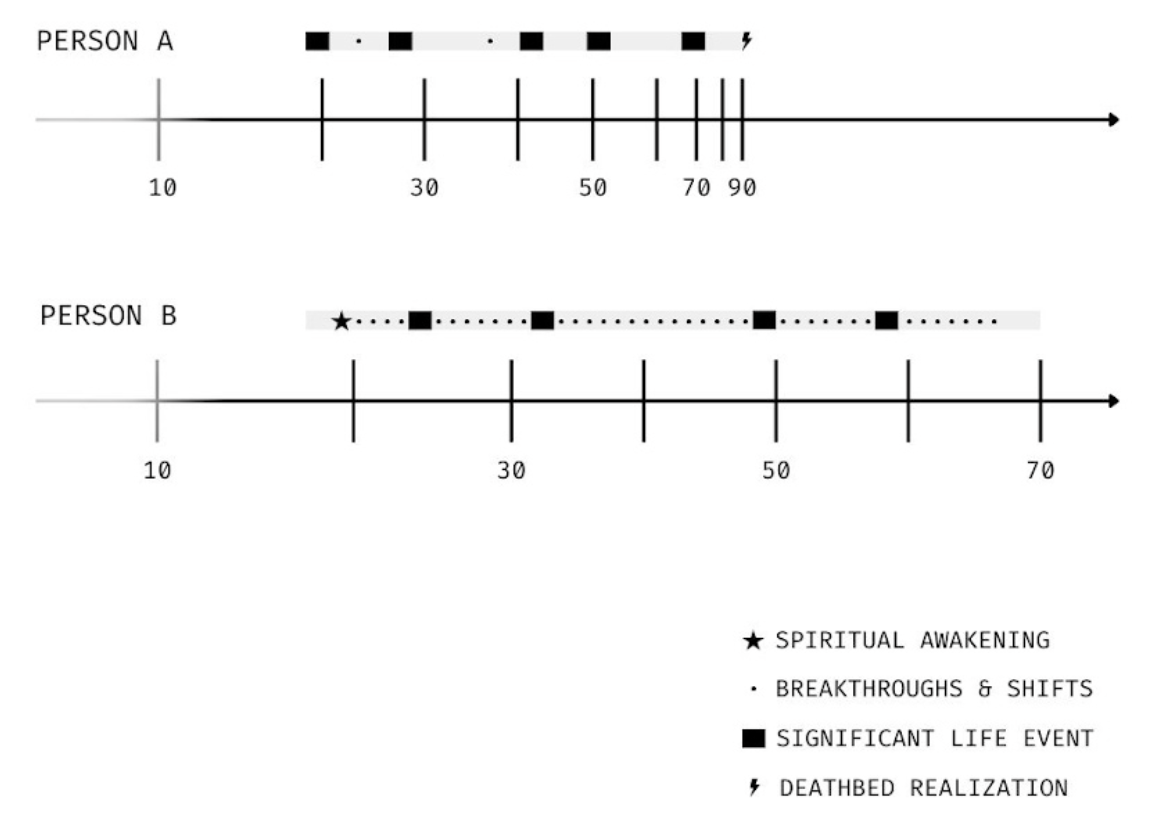
Over time, life seems to reward Person B with more felt time. They value detail, depth, and awareness, and their experience reflects that. Time appears to elongate within their reality frame.
More awareness per moment equals more life – not just within each moment, but in how life is remembered and integrated overall.
On the flip side, when you neglect inner work, numb your senses, or move through life on autopilot, you lower the resolution of your experience.
Think of it like playing a 4K movie in 240p. You’re still watching the movie, but you’re barely seeing anything. Life becomes a blur.
That’s why people say things like “it felt like yesterday” – because between then and now, their system was largely offline. Time collapsed in memory. The years passed through them like wind through a ghost.
That’s the trap of unconscious living: you may live 80 years on paper, but only experience five.
You’d expect to hear the opposite from an evolving, time-conscious person – something like “I remember that clearly, but I’m not the same person I was back then.”
They may be able to close their eyes and revisit that period, but it doesn’t feel like it could have been yesterday.
Old pockets of life feel like different reality frames or distant dreams to someone who keeps evolving. They don’t remain static.
I’ve come to think of time as something like a reward signal inside the system we’re operating in.
The more consciousness you bring to a moment, the more that moment expands.
The less you bring, the more time slips through your fingers.
A simple way to think about it:
Disregard time → life fast-forwards.
Refine consciousness → time appears to slow.
This may also explain why flow state feels timeless. You align fully with presence, creative output, and coherence. Nothing is leaking.
In those moments, you experience what feels like infinity inside a second.
So time may not actually pass in ticks, seconds, or minutes the way we intuitively think it does, but in how many high-energy imprints we create along the way.
In that sense, you don’t get more time by wishing for it.
You get more time by using what you already have at a higher resolution.