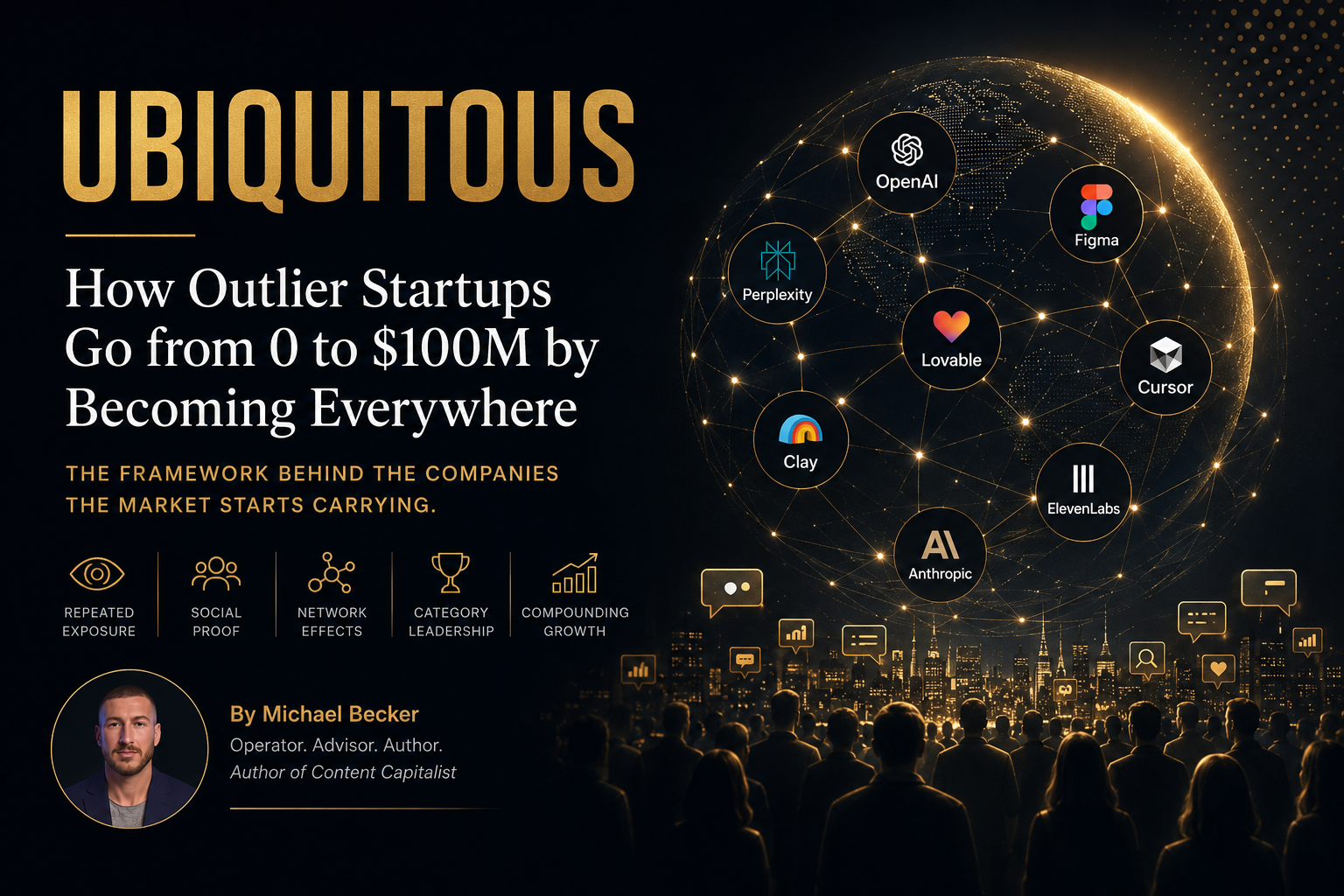
Something unusual is happening in technology.
A small number of companies are moving from unknown to seemingly everywhere at remarkable speed. Figma. Cursor. OpenAI. Perplexity. Clay. Lovable.
At first, they are simply another product in a crowded market. Then their names start appearing in founder conversations, group chats, podcasts, product comparisons, search results, investor decks, customer workflows, creator content, and internal company discussions.
Eventually, buyers arrive already familiar with them.
Customers recommend them without being asked. Competitors position themselves in relation to them. The company begins to feel larger, safer, and further ahead than its revenue or headcount alone would suggest.
That transition is what my new book, Ubiquitous, is about.
A startup becomes ubiquitous when it enters the shared awareness of its market.
The interesting question is how that happens.
Technology Has an Attention Problem
Software used to be difficult to build.
Creating a credible product required substantial capital, engineering talent, infrastructure, and time. Production itself was a major constraint.
AI is changing that.
Small teams can now research, design, code, write, analyze, automate, support customers, and launch products at a level that previously required much larger organizations.
That is great for builders.
It also means the number of credible products is increasing dramatically.
More software. More vendors. More creators. More content. More messages competing for the same buyers.
Human attention is not expanding at the same rate.
So the competitive advantage is shifting.
Building something good remains essential. But increasingly, the winners will also be the companies that become disproportionately recognized, remembered, discussed, tried, and trusted.
Ubiquity Is More Than Awareness
Ubiquity is easy to confuse with reach.
It is not about buying enough impressions or publishing enough content until your logo appears everywhere.
A company can generate enormous reach without creating meaningful market presence.
Ubiquity begins when repeated encounters start reinforcing one another.
Someone sees the founder discussing a problem.
Later, a colleague shares something made with the product.
Then the company is mentioned on a podcast.
A creator demonstrates it.
The buyer encounters it while researching a solution.
At some point, the individual encounters become less important than the impression they collectively create:
This company is everywhere.
That perception changes buyer psychology.
Familiar products feel safer. Familiar companies feel more established. Repeated visibility creates the sense that other people already know, trust, and use the product.
The Ambient Infiltration Effect
Sometimes we know a company before we remember learning about it.
There was no single discovery moment.
You saw the logo in a screenshot. Someone mentioned the product. You watched a short demo. A colleague sent you a link. Then you encountered the company again somewhere else.
Eventually, you remember the company but forget the individual exposures that introduced it.
I call this the Ambient Infiltration Effect.
Repeated, low-attention encounters gradually insert a product into the mental map of its market.
Over time, this can create what I call ambient authority: the feeling that something must already be important because it keeps appearing through independent sources.
This is why repeated exposure through customers, creators, founders, communities, search, product outputs, and trusted peers can be so powerful.
It does not feel like one company repeatedly advertising itself.
It feels like the market independently confirming the company’s importance.
The Four Exposure Rule
One encounter rarely creates meaningful recognition.
My working model is that several strong encounters need to accumulate within a relatively short period before a company begins moving from unfamiliarity toward recognition and curiosity.
I call this the Four Exposure Rule.
Imagine a buyer who, within two weeks:
- Sees the founder explain an emerging problem
- Receives a product-generated artifact from a colleague
- Hears the company mentioned on a podcast
- Finds the product while researching a solution
Those four encounters reinforce one another.
Four generic ads would produce a very different effect.
That distinction is why I also use the Ubiquity Quotient: a way of thinking about the quality of those encounters.
Were they credible?
Did they come from different sources?
Were they memorable?
Did they happen close enough together to reinforce one another?
Did they come through people or environments the buyer already trusts?
Ubiquity is created by the pattern, not simply the impression count.
When Product Usage Becomes Distribution
Some of the most powerful software companies have another advantage: using the product exposes someone else to it.
A Figma file.
A Loom video.
A Canva design.
A Calendly link.
A dashboard.
An AI-generated application.
A report.
I call these shareable artifacts.
They create value for the existing user while simultaneously demonstrating the product to someone new.
Figma is one of the clearest examples.
A designer creates a file and shares it with engineers, product managers, executives, clients, and coworkers.
Figma therefore does not need to acquire every new person through traditional marketing.
The work itself introduces the product.
The product becomes its own distribution mechanism.
That is a fundamentally different growth dynamic.
Density Before Scale
Another important principle is that raw user count can be misleading.
Fifty users inside one tightly connected community can create more momentum than one thousand users spread randomly across unrelated companies.
Connected people talk.
They observe one another.
They share tools.
They trust recommendations.
They repeatedly encounter evidence from the same product.
This is why I believe early companies should often seek density before scale.
Become highly visible inside one meaningful network.
Become the tool people in that community keep encountering.
Then expand outward.
Local ubiquity can precede broad market ubiquity.
The Ubiquity Moment
Eventually, some companies cross a threshold.
Before that point, the company creates most of its own momentum.
The marketing team publishes. The founder posts. Sales reaches out. The company runs campaigns.
Then the ratio changes.
Customers begin talking about the product independently.
Creators cover it voluntarily.
Branded search rises.
Direct traffic increases.
Product outputs circulate.
Employees bring the tool into new companies.
Enterprise buyers arrive already knowing the name.
The amount of attention and validation being produced around the company begins exceeding what the company itself directly generates.
I call this the Ubiquity Moment.
The market has started participating in growth.
And once that happens, the economics of distribution change.
The Companies the Market Carries
This is ultimately the idea behind Ubiquitous.
The next generation of category-defining companies will not simply run better marketing.
They will build products whose value travels.
They will deliver value quickly enough that more users reach activation.
They will make successful usage visible.
They will concentrate adoption inside connected networks.
They will become memorable through repeated exposure.
They will embed themselves deeply enough into workflows that usage keeps expanding.
They will design pricing that captures value without preventing adoption from spreading.
And if enough of those mechanisms reinforce one another, the company reaches a different state.
It no longer has to carry the entire burden of growth itself.
The market begins carrying it.
That is ubiquity.
And that is the system I am exploring in Ubiquitous: How Outlier Startups Go from 0 to $100M by Becoming Everywhere.