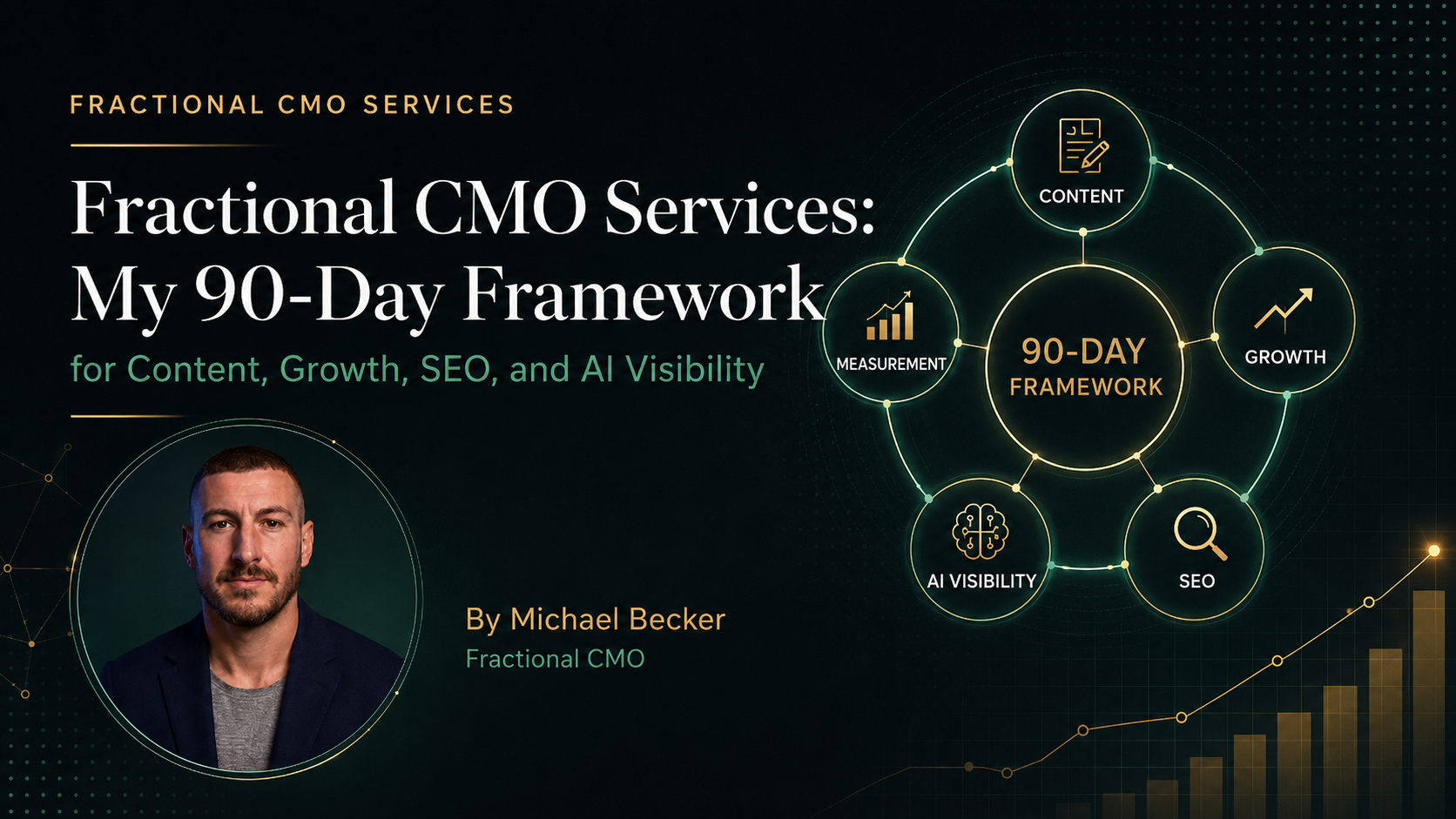
By the time a company hires a fractional CMO, the symptoms are usually obvious:
- Growth has slowed.
- Content production feels disconnected from revenue.
- SEO traffic is flat.
- Teams are busy but priorities are unclear.
- AI has introduced uncertainty around what marketing should even look like going forward.
The first 90 days determine whether a fractional engagement creates momentum or becomes another expensive strategy document that sits in a folder.
This is the framework I use when I step into a company as a fractional CMO, fractional Head of Content, or strategic growth advisor.
Step 1: Interview the Business Before Changing the Business
Many marketing problems are not marketing problems.
They’re communication problems.
Before recommending new campaigns, channels, content strategies, or AI initiatives, I spend time interviewing key stakeholders across the company.
This usually includes:
- Founder or CEO
- Revenue leadership
- Product leadership
- Customer success
- Sales representatives
- Existing marketing team members
- Power users or customers
The goal is simple:
Identify where perception differs from reality.
Founders often believe they have a traffic problem when they actually have a positioning problem.
Marketing teams often believe they have a content problem when they actually have a distribution problem.
Sales teams often believe they have a lead problem when they actually have a messaging problem.
The faster these gaps become visible, the faster meaningful progress can begin.
Step 2: Audit Every Customer Touchpoint
Most companies underestimate how fragmented their digital presence has become.
A modern content audit extends far beyond the company blog.
I typically evaluate:
- Website architecture
- Product positioning
- Landing pages
- SEO performance
- Conversion paths
- Email programs
- Social media presence
- Sales enablement content
- Customer onboarding materials
- Knowledge bases
- Community assets
- Video content
- AI discoverability
In many cases, years of content exist but little of it is actively contributing to growth.
The goal is not simply to create more content.
The goal is to identify what should be:
- Updated
- Consolidated
- Repurposed
- Expanded
- Retired
The highest ROI content strategy often begins with optimization rather than creation.
Step 3: Assess SEO and AI Search Visibility
Traditional SEO is no longer enough.
In 2026, companies must optimize for both search engines and AI engines.
I evaluate visibility across:
- Google Search
- AI Overviews
- ChatGPT
- Perplexity
- Claude
- Gemini
- Bing Copilot
This requires a different approach than SEO alone.
Key evaluation areas include:
Topical Authority
Do you own meaningful categories within your market?
Or are you publishing isolated content pieces without strategic depth?
Entity Development
Do search engines and AI systems clearly understand:
- Your company
- Your products
- Your executives
- Your expertise
Citation Readiness
Can AI systems easily find and reference your content?
Or is your expertise trapped inside PDFs, webinars, sales decks, and gated assets?
Knowledge Distribution
Have your best insights been distributed across:
- Website content
- Industry publications
- Podcasts
- Communities
- Video
Modern visibility increasingly depends on becoming a recognized source rather than simply ranking pages.
Step 4: Identify Growth Bottlenecks
Every company has one or two constraints limiting growth.
The challenge is finding the real constraint.
Examples include:
- Weak positioning
- Low website conversion rates
- Insufficient content production
- Poor content distribution
- Limited brand awareness
- Weak email nurture systems
- Inconsistent sales messaging
- Lack of customer proof
- Low AI visibility
- Product onboarding friction
Most companies attempt to solve ten problems simultaneously.
The highest-performing organizations identify the single bottleneck producing the greatest downstream impact.
That’s where resources should go first.
Step 5: Align Content to Revenue
One of the biggest mistakes I see is treating content as a standalone function.
Content should support the entire customer journey.
That means building assets for:
Awareness
- Thought leadership
- Industry commentary
- Research
- SEO content
- AI discoverability
Consideration
- Case studies
- Comparison pages
- Buying guides
- Product education
Decision
- Sales enablement
- Customer stories
- ROI frameworks
- Objection handling
Expansion
- Onboarding content
- Adoption content
- Customer education
- Retention programs
Every major content initiative should connect to a business objective.
Step 6: Build an AI-Native Content System
The companies gaining ground today are not using AI to produce more content.
They’re using AI to increase leverage.
Typical initiatives include:
- AI-assisted research workflows
- Content repurposing systems
- Automated distribution pipelines
- Knowledge extraction from internal experts
- Prompt libraries
- Editorial automation
- AI-driven content briefs
- Content performance analysis
The objective is not replacing marketers.
The objective is allowing small teams to perform at enterprise scale.
Step 7: Create a 12-Month Roadmap
After completing audits, interviews, and opportunity assessments, I typically build a prioritized roadmap covering:
Quick Wins (0-90 Days)
- Conversion improvements
- Content updates
- SEO fixes
- AI visibility improvements
- Messaging refinements
Growth Initiatives (3-6 Months)
- Content engines
- Distribution programs
- Demand generation initiatives
- Authority building
Strategic Investments (6-12 Months)
- Category creation
- Brand development
- Community building
- Market leadership initiatives
This prevents teams from confusing urgent work with important work.
What Fractional CMO Engagements Should Actually Deliver
A good fractional CMO does more than provide advice.
They create focus.
The best engagements produce:
- Clear priorities
- Better decision-making
- Faster execution
- Stronger positioning
- More efficient content operations
- Increased search visibility
- Greater AI discoverability
- Measurable revenue impact
The goal is not to add more marketing activity.
The goal is to build a marketing system that compounds over time.
I discussed many of these ideas during a podcast conversation with Jessica Shirra on Dean Waite’s Fractional CMOs and the 90-Day Win series in 2024. Listen to the interview here. If you’re evaluating whether a fractional CMO, fractional Head of Content, or growth advisor makes sense for your company, feel free to reach out.