Surge AI × Michael Becker
Recruiting the experts frontier AI models cannot afford to get wrong.
Surge AI needed a more effective acquisition motion for a scarcer audience: Nobel laureates and professors from top universities who could evaluate, review and improve generative AI outputs. I redesigned the strategy around precision recruitment, high-trust outreach and a lower-friction invite experience.
$50K/wk
Original campaign budget
3×
Budget increase implied at current pace
2 weeks
Recruitment window in the brief
4 channels
Paid · organic · email · demand gen
The mandate
The STEM PhD playbook stopped working when the audience became scarce.
The starting journey was landing page → signup → phone verification → assessment. Reapplying the existing acquisition strategy to Nobel laureates and top-tier professors caused conversion to fall sharply and CAC to become prohibitive.
The brief was to hit the recruitment target in two weeks without simply tripling spend.
The core diagnosis
Known supply → named targets → high-trust outreach → invited onboarding → paid expert work.
Strategic reframe
From scaled acquisition to precision recruitment.
The new motion matched effort to the value and scarcity of each target instead of treating professors and laureates like another paid-media audience.
Diagnose message, trust and source.
Run 3–5 informational interviews with PhDs, professors and comparable experts. Walk them through the current ads, email, landing page and assessment path. Identify who they would respond to, which claims they trust and what would make the opportunity worth their time.
What ships
Motivation map · objections · trusted senders · audience language · revised value proposition
Rank people, not impressions.
Build a named target list across core AI / LLM institutions, applied science, medicine, bio, law, finance and economics. Segment by likely value, accessibility, expertise and expected contribution volume.
What ships
Tier 1 named experts · Tier 2 university cohorts · Tier 3 broader academic pool · research fields
Manual at the top; automation below.
Use founder- or executive-led 1:1 outreach for the highest-value experts, research-backed semi-personalization for top professors and domain-segmented automation for the broader pool. Evaluate economics separately by tier.
What ships
Email + LinkedIn sequences · personal research · custom Looms · test matrix · CAC by tier
Build trust before asking for work.
Use testimonials from current PhDs, short expert interviews repurposed into articles, university and research-group access, and referral introductions. Test non-cash value where it strengthens participation or warm introductions.
What ships
Expert proof · interview series · referral mechanics · university access tests · partnership targets
Conversion experience redesign
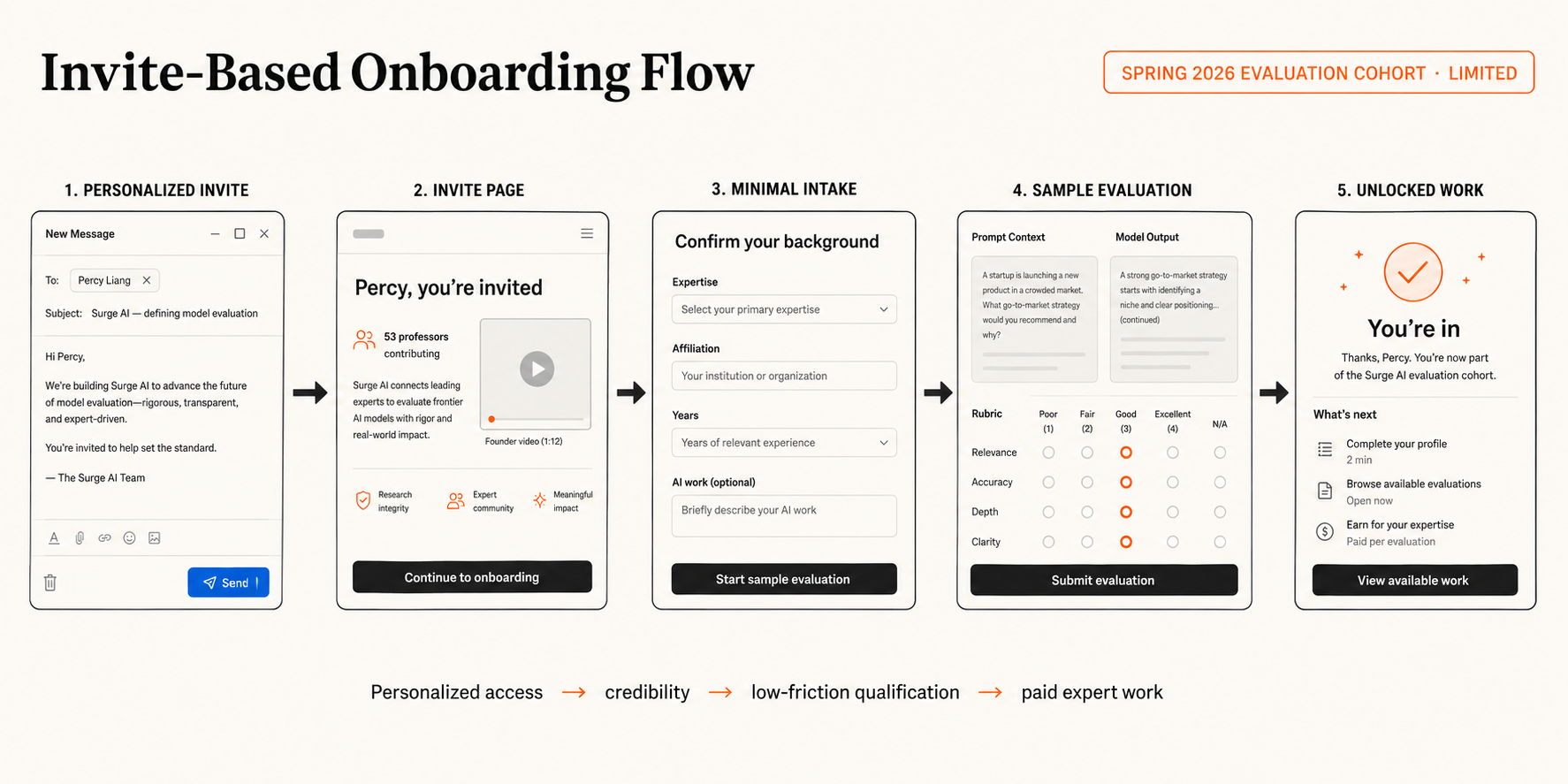
The funnel should feel like an invitation, not an application.
For a scarce expert cohort, relevance and legitimacy need to precede data capture. I replaced the cold signup journey with personalized access, a contextual invite page, minimal intake, a representative sample evaluation and immediate access to available paid work.
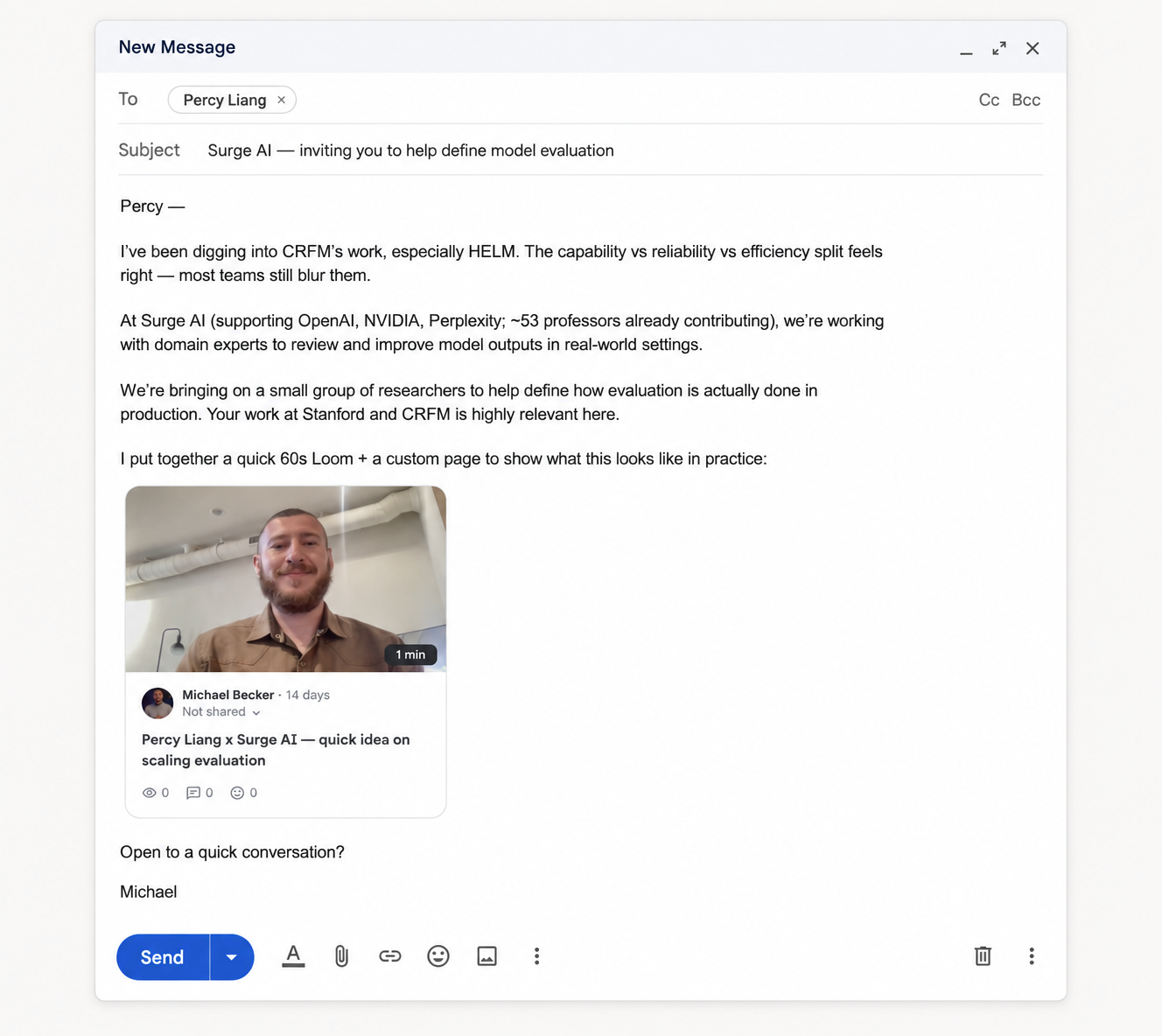
Example: personalized professor outreach
Evidence of research before the ask.
I mocked a message to Stanford professor Percy Liang that referenced CRFM and HELM before introducing Surge. The operating principle was simple: the most valuable experts receive proof that Surge understands their work before Surge asks for their attention.
Tiered outreach standard
Tier 1: individual research + executive sender + custom video/page.
Tier 2: research-backed semi-personalization.
Tier 3: domain-specific automation.
Target architecture
A named expert market, organized by value and access.
The practical advantage is that this audience can be enumerated. Surge can build its own expert graph instead of continually purchasing broad academic reach.
AI / LLM
Core research centers
Stanford, MIT, Carnegie Mellon, UC Berkeley, University of Washington and University of Toronto, prioritized by research fit and individual relevance.
Domain
High-stakes expertise
Medicine, biology, law, finance and economics via Johns Hopkins, Harvard, Yale, Chicago, Penn, NYU and comparable institutions.
Access
Institutional + referral routes
Research groups, university departments, expert associations, warm introductions, contributor referrals and selective partnership exploration.
Two-week operating plan
Diagnose quickly. Launch controlled tests. Scale only verified motions.
Days 1–2 / Diagnose
Validate the audience assumptions.
Conduct expert interviews, audit current acquisition touchpoints, clarify the target count and value threshold, establish tier definitions, and identify the highest-leverage trust signals.
Output: revised brief, target scorecard, message architecture and funnel friction map.
Days 3–7 / Launch
Stand up the dual motion.
Build the ranked list, ship the invite page, deploy Tier 1 personalized outreach, launch Tier 2 sequences, begin credibility content, and instrument every funnel stage by audience and channel.
Output: live outreach, invite experience, test dashboard and first response data.
Days 8–14 / Optimize
Move spend toward verified conversion.
Cut weak messages and segments, increase manual effort where target value justifies it, expand the strongest sequences, activate referrals and partnerships, and resolve onboarding friction daily.
Output: cohort economics, winning motions, recruited experts and next-30-day scale plan.
Measurement system
Measure qualified expert activation, not cheap clicks.
Each tier should have its own economics. The decision metric is cost and speed per qualified, activated contributor—not aggregate lead volume.
Reply rate
by target tier, sender, domain and channel
Invite → start
context-page and onboarding-start conversion
Task pass
sample-evaluation completion and qualification
Time to work
hours from first contact to first paid task
Cost / active expert
fully loaded acquisition cost by tier
How I worked
First-principles diagnosis, then AI-assisted synthesis.
I began with an unfiltered hypothesis log: what leadership actually valued, whether the failure sat in the channel or message, how many experts mattered, where prestige changed the conversion dynamic, and which assumptions needed validation. I then used GPT to organize the constraints, pressure-test the funnel math and turn the raw reasoning into an executable plan.
Work sequence
01. Document assumptions and unanswered questions.
02. Clarify targets, constraints and decision thresholds.
03. Build the target, channel, funnel and budget model.
04. Translate the strategy into artifacts a team could ship.
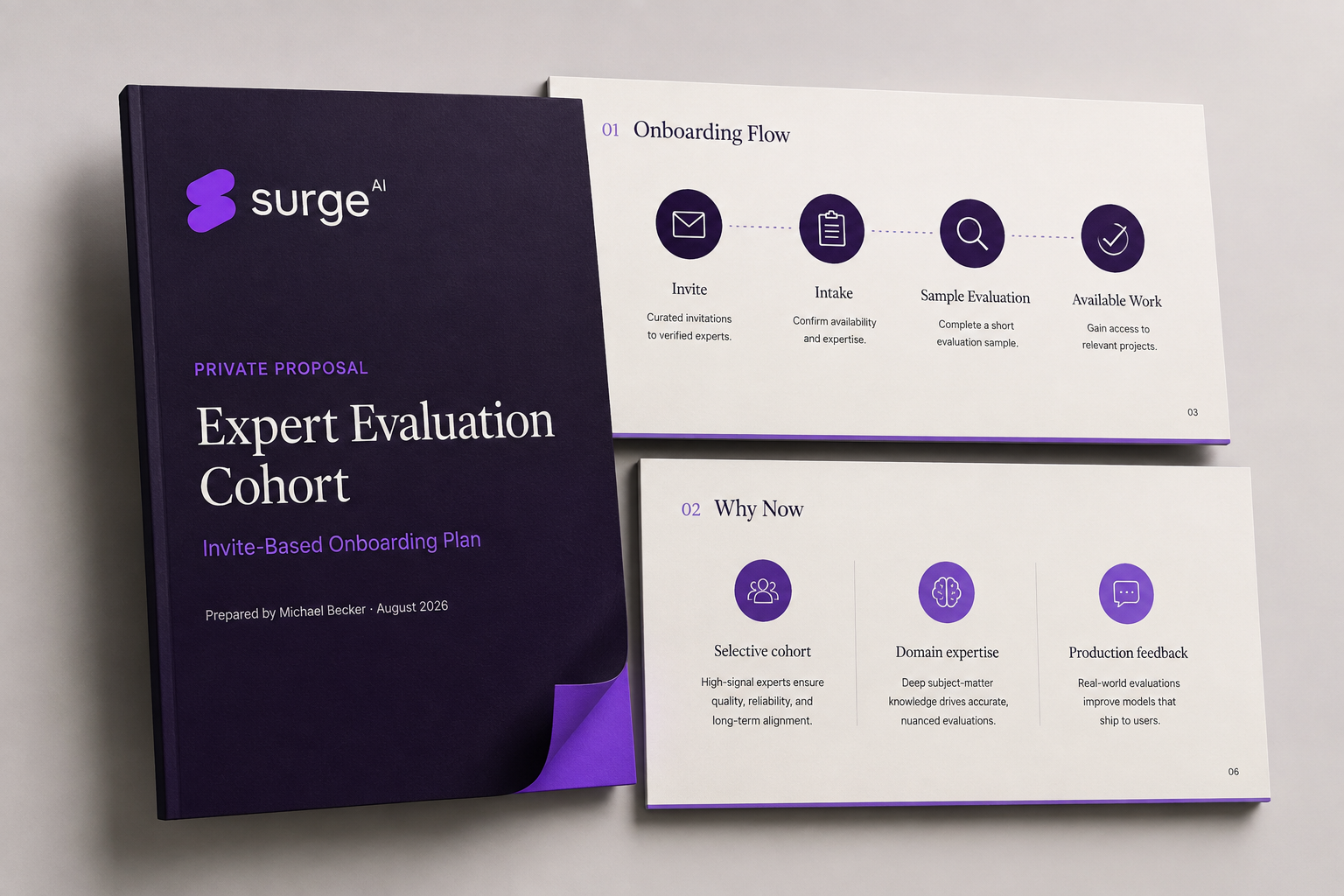
The complete deliverable
The acquisition strategy, funnel redesign and operating plan.
The deck contains the problem diagnosis, strategic reframe, quantitative target model, budget reallocation, channel plan, messaging shift, invite-based onboarding concept, alternate access plays, two-week execution plan and KPI framework.
The reusable capability
When the audience is scarce, the growth system must become more exact.
This project demonstrates how I approach high-value acquisition mandates: clarify the economics, identify the finite market, redesign the conversion path and deliver the messages and assets needed to launch.
Michael Becker · Growth Strategy · Expert Acquisition · AI / SaaS
Portfolio case study documenting a proposed strategy and prototype assets. No implementation results are claimed.